
Categories
Industry

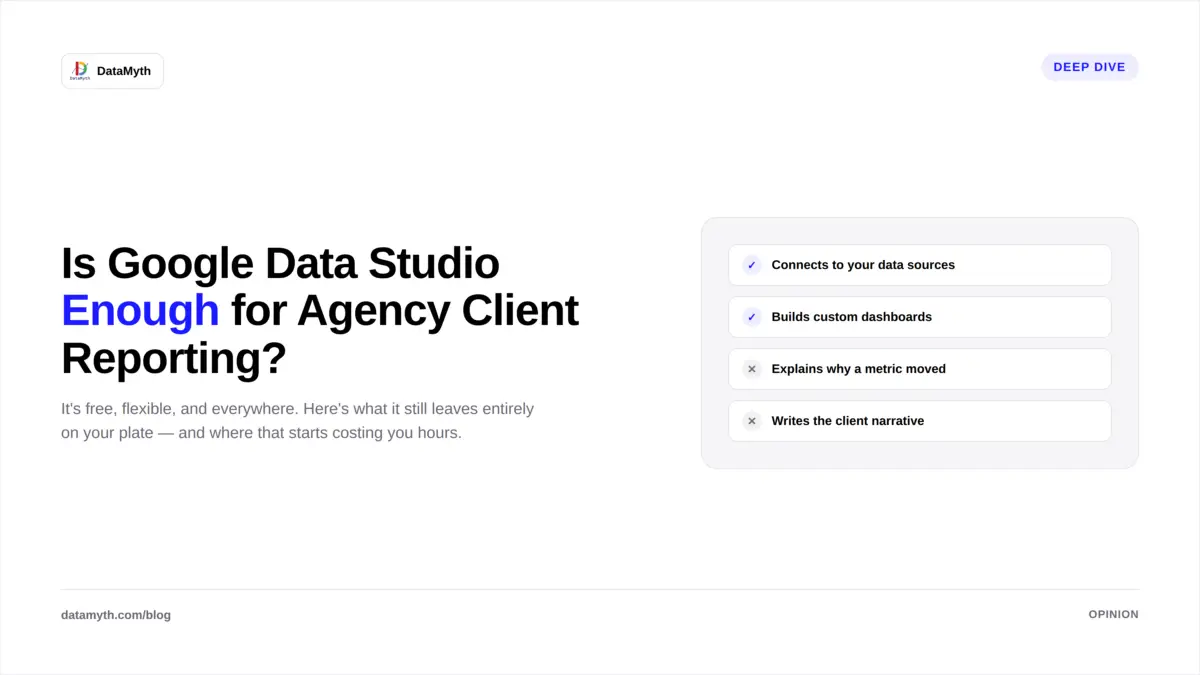
Is Google Data Studio Enough for Agency Client Reporting?

Introduction

Google Data Studio (now Looker Studio) is often the first stop for agencies building client dashboards, mainly because it’s free and connects natively with Google’s own tools. But “free and flexible” doesn’t always mean “fast and complete,” especially once reporting becomes a recurring, multi-client task.

Why Agencies Start With Google Data Studio

It’s free, integrates tightly with Google Analytics and Google Ads, and offers deep customization for anyone comfortable building dashboards from scratch. For agencies with technical resources, this flexibility is a real advantage.

Where the Limits Show Up

  • Building each dashboard from scratch takes real time, especially across many clients with different metrics.
  • There’s no built-in written analysis, every insight has to be manually derived and typed out.
  • Non-Google data sources, like Meta Ads or LinkedIn Ads, often require third-party connectors that add setup complexity.

Where DataMyth Picks Up the Slack

DataMyth is built to skip the dashboard-building step entirely, offering ready templates plus automatically written performance insights, addressing the two biggest gaps agencies hit with Google Data Studio. For teams that started on Data Studio but found themselves rebuilding the same dashboard logic for every new client, this cuts a significant amount of repetitive setup work.

When Google Data Studio For Agencies Still Makes Sense

  • If you have in-house technical resources to build and maintain custom dashboards.
  • If your reporting needs are simple and mostly stay within the Google ecosystem.
  • If cost is the primary constraint and you can absorb the manual setup time.

Conclusion

Google Data Studio remains a capable, free tool, but its manual setup and lack of automated interpretation make it a heavier lift for agencies scaling across many clients. DataMyth targets exactly that gap, with ready templates and written insights built in from day one.

Is Google Data Studio free?

Yes, Google Data Studio (Looker Studio) is a free tool from Google, though building and maintaining dashboards still requires time and some technical know-how.

Does Google Data Studio explain why metrics changed?

No, it visualizes data but doesn’t generate written analysis; that interpretation has to be done manually by the user.

Can Google Data Studio connect to non-Google platforms?

Yes, but it typically requires third-party connectors for platforms like Meta Ads or LinkedIn Ads, adding setup complexity.

Why do agencies move from Google Data Studio to DataMyth?

Agencies typically switch when manual dashboard-building and writing performance commentary become too time-consuming across a growing client base.

Categories
Industry

DataMyth the AgencyAnalytics Alternative in 2026

Introduction

If you’ve been searching for an AgencyAnalytics alternative, you’re probably running into one of three problems: the pricing is scaling faster than your client list, you want reporting that explains performance rather than just charting it, or you simply want to compare your options before renewing a contract. This guide breaks down what to actually look for in an alternative, the main categories of tools available, and where DataMyth fits if your priority is automated, insight-driven reporting.

Why Agencies Look for an AgencyAnalytics Alternative

AgencyAnalytics is a well-established, all-in-one reporting platform, and for many agencies it works well. But agencies typically start evaluating alternatives for a few recurring reasons:

  • Per-client pricing that grows quickly as the client roster grows, which can strain margins for smaller agencies.
  • Reports that are strong on visualisation but still require a human to write the narrative, the “why did this change” explanation clients actually read.
  • A desire for a lighter, more focused tool rather than a broad platform bundling SEO auditing, rank tracking, and reporting together.
  • Wanting more flexibility in how white-label reports are branded, structured, and delivered.

What to Compare When Evaluating Alternatives

Not all reporting tools solve the same problem. Before comparing specific products, it helps to know which category you actually need:

  • All-in-one reporting platforms, combine data connections, dashboards, and scheduled client reports in one product (this is the category AgencyAnalytics and DataMyth both sit in).
  • Data pipeline tools, extract and load marketing data into a warehouse or spreadsheet, leaving you to build the report yourself. Useful if you already have a BI stack, overkill if you don’t.
  • Dashboard-only tools, strong on live visualisation, lighter on scheduled, narrative client reports.

Once you know which category fits, the real differentiators come down to: how the tool is priced as you scale, how much manual work is left after the report is generated, and how the report explains performance rather than just displaying it.

Where DataMyth Fits

DataMyth is built specifically for agencies that want to hand a client a report that reads like an analyst wrote it, without an analyst spending the hours. Rather than only visualising metrics, DataMyth automatically generates written performance insights alongside the data: the platform explains what changed and offers a plain-language reason, so account managers spend less time writing commentary before every client call.

For agencies specifically comparing an AgencyAnalytics alternative, the practical differences to weigh are: how reporting is priced as your client list grows, how much white-label control you get over report structure and branding, and how much of the report is written for you versus left as raw charts you have to interpret yourself.

How to Make the Switch Without Disrupting Clients

  • Run your new tool in parallel with your current one for one full reporting cycle before cancelling anything.
  • Rebuild your most-used report templates first, then expand to less frequent ones.
  • Let clients know reporting is being upgraded before the first report change arrives in their inbox, most clients respond well to “you’ll now get more detail,” not just a new logo.

Conclusion

There’s no single “best” AgencyAnalytics alternative, the right choice depends on whether you need an all-in-one platform, a data pipeline, or a tool built specifically around explaining performance rather than just displaying it. If writing (or rewriting) client commentary every reporting cycle is the part of the job eating your team’s time, that’s the gap DataMyth is built to close.