
Yes, you can schedule automated client reports. Modern marketing reporting platforms let you connect your client’s channels once, configure a report template, set a delivery schedule, and have the report generate and send automatically, without touching it manually each period. Here is exactly how to do it and what to think through before you set it up.
What Does It Mean to Schedule Automated Client Reports?
Scheduling automated client reports means configuring a reporting system to generate and deliver formatted performance reports at a set interval, weekly, monthly, or quarterly, without requiring manual data export, template updates, or written commentary each time. The system pulls live data from connected channels, applies the report layout, generates any written analysis, and delivers the report (as a link or PDF) to the recipient automatically.
The result: on the first Monday of every month, your client’s report arrives in their inbox without your team spending three hours assembling it.
How Do You Set Up Scheduled Client Report Delivery?
Setting up scheduled automated client reports involves five steps:
Step 1 – Connect data sources. Link your client’s channels, GA4, Google Ads, Facebook Ads, LinkedIn Ads, Google Search Console, to your reporting platform using secure OAuth authentication. This is a one-time setup per client account. No manual exports after this point.
Step 2 – Choose or build a report template. Select a template that matches the client’s reporting needs. A Google Ads-focused report looks different from a cross-channel agency report. Most platforms offer pre-built templates by channel; DataMyth provides channel-specific templates with automated analysis built in.
Step 3 – Configure the reporting period. Set the default date range, last 30 days, last month (calendar), or a custom range. Decide whether it compares to the prior period automatically.
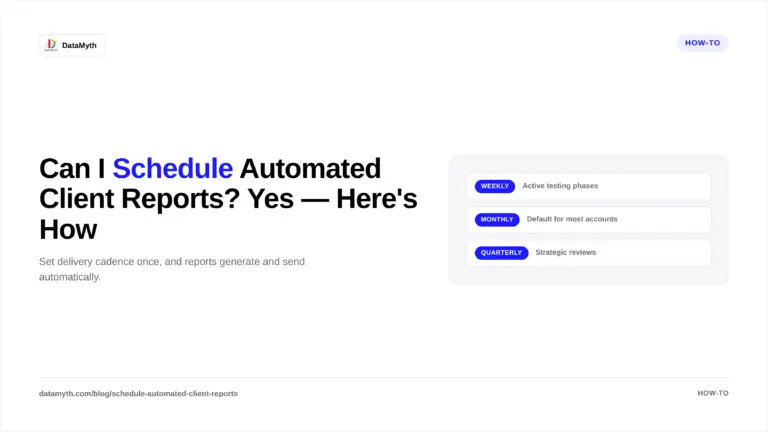
Step 4 – Set the schedule. Choose the delivery frequency: weekly (typically for active testing phases), monthly (default for most client accounts), or quarterly (for strategic review reports). Set the exact delivery day and time. Monday morning delivery works well, clients often review performance at the start of the week.
Step 5 – Set recipients and delivery format. Add the client contact email and any internal stakeholders. Choose between a live link (always shows current data) or a PDF snapshot (fixed at generation time). For most client-facing reports, a PDF snapshot is cleaner, it represents the period as it was when you sent it.
What Should You Automate First in Your Client Reporting Workflow?
Prioritize automating the parts of reporting that consume the most time with the least strategic value:
| Reporting task | Automate? | Why |
|---|---|---|
| Data export from each platform | Yes, immediately | Pure mechanical work, no judgment required |
| Report formatting and layout | Yes | Template-driven, consistent across clients |
| Period-over-period calculations | Yes | Arithmetic, not analysis |
| Written performance analysis | Yes (if tool supports it) | Biggest time sink; DataMyth generates this automatically |
| Strategic recommendation | No | Requires account knowledge and judgment |
| Client communication context | No | Relationship-specific, cannot be templated |
The written analysis is the most important item to automate if your tool supports it. Agencies report spending 2–4 hours per client per month writing the “what changed and why” narrative. Automating this, while retaining the strategic recommendation, recovers the majority of reporting time without reducing the value you deliver.
How Often Should Scheduled Client Reports Run?
Monthly is the right default for most client accounts. Monthly cadence gives enough data for meaningful trend analysis, aligns with budget cycles, and gives clients the rhythm they expect. Weekly reports are appropriate during active A/B testing phases or when a client is launching a new campaign and wants frequent visibility. Quarterly reports serve strategy reviews.
The scheduling decision should match how fast the channel moves:
- Google Ads (active): Weekly during launch, monthly ongoing
- Facebook Ads (active testing): Weekly or bi-weekly during creative testing, monthly ongoing
- SEO / organic: Monthly (weekly organic data is mostly noise)
- LinkedIn Ads: Monthly (B2B sales cycles are too long for meaningful weekly movement)
- Cross-channel summary: Monthly, with quarterly strategic review
One practical note: schedule the report to generate 24–48 hours before delivery to allow time for a human review. A scheduled report that goes directly to the client without review creates accountability gaps. The scheduling system handles the generation; your team handles the final read and send.
Can You Schedule Automated Client Reports for Multiple Clients at Once?
Yes. A reporting platform built for agencies, like DataMyth, lets you manage multiple client accounts in a single interface, each with its own template, schedule, and recipient list. Adding a new client’s account does not require rebuilding your reporting infrastructure; you connect the channels, apply the template, and configure the schedule in minutes.
This is the scalability argument for automation: the 30th client account costs nearly the same reporting effort as the first, because the system handles the repetitive steps for all of them simultaneously. See how DataMyth handles agency reporting at scale.
Can I schedule automated client reports to go out automatically?
Yes. Connect your client’s data sources to a reporting platform, configure the template and schedule, and the report generates and delivers itself at the set interval, no manual trigger required.
How do I automate monthly client reports for paid media?
Connect your Google Ads and Facebook Ads accounts to a reporting platform. Set a monthly schedule and choose a paid media template that includes spend, conversions, cost per conversion, and ROAS. DataMyth automates the data pull, report generation, and written analysis, so the monthly paid media report produces itself.
What is the best cadence for automated client reports?
Monthly is the right default. Use weekly during active campaign launches or A/B testing phases. Quarterly for strategic reviews. Match the cadence to how fast the channel moves, SEO reports monthly; active paid media can go weekly during testing.
Does scheduling a report replace the account manager?
No. Scheduling automates the data pull, formatting, and written analysis narrative. Strategic recommendations, client relationship management, and account optimization decisions still require human judgment. Automation recovers time so account managers can focus on the work that requires their expertise.
What channels can be included in a scheduled client report?
Most marketing reporting platforms support GA4, Google Ads, Facebook Ads, LinkedIn Ads, and Google Search Console. DataMyth supports all five in a single automated report with written performance analysis.
How long does it take to set up scheduled automated client reports?
Initial setup takes 15–30 minutes per client: connecting channels, selecting the template, configuring the schedule, and adding recipients. After that, the report runs automatically each period with no further input.