
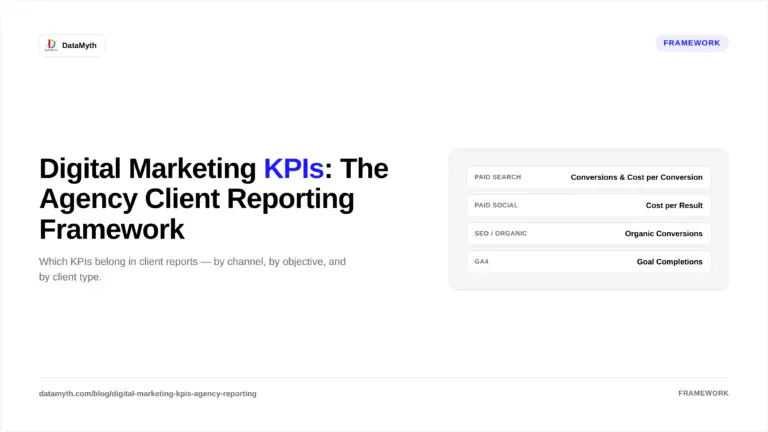
Choosing the wrong digital marketing KPIs for a client report is not a minor formatting issue, it’s a trust problem. When a PPC agency reports impressions to a client who needed leads, or an SEO agency highlights keyword rankings to a client who needed revenue, the report technically shows real data while completely failing to demonstrate value.
This framework maps the right KPIs to the right clients by channel, objective, and business type, so every report you send measures what the client actually hired you to deliver.
What Are Digital Marketing KPIs and Why Do They Vary by Client?
Digital marketing KPIs are the specific, measurable indicators that show whether a marketing activity is achieving its business goal. They vary by client because different clients have fundamentally different objectives. A B2B SaaS company measures qualified leads and pipeline contribution. An e-commerce brand measures ROAS and revenue. A local service business measures calls, form fills, and cost per acquisition.
Reporting the same metrics to all three clients treats their businesses as interchangeable. The framework below sets KPIs by channel and overlays business objective filters.
Which Digital Marketing KPIs Matter by Channel?
Paid Search (Google Ads)
Primary KPIs:
- Conversions (leads, purchases, or calls, match to objective)
- Cost per Conversion
- Conversion Rate
- ROAS (e-commerce only)
Context KPIs (supporting, not headline):
- Impression Share
- Average CPC
- Quality Score trends
- Search Term match efficiency
Omit from client-facing reports: Average position (deprecated), click volume without conversion context.
Paid Social (Facebook / Meta, LinkedIn)
Primary KPIs:
- Results (leads, purchases, whatever the campaign objective is)
- Cost per Result
- ROAS (e-commerce)
- Lead Form Completion Rate (LinkedIn / Meta lead campaigns)
Context KPIs:
- Frequency (creative fatigue signal)
- Link CTR
- Demographic breakdown (LinkedIn-specific)
Omit: Reactions, shares, 3-second video views, reach as a success metric.
SEO / Organic Search
Primary KPIs:
- Organic Sessions
- Organic Conversions (or assisted conversions)
- Revenue from Organic (if tracked)
- Keyword Ranking Movement (for target terms)
Context KPIs:
- Click-Through Rate from Search Console
- Impressions trend (Search Console)
- Backlinks acquired
Omit: Domain authority as a client-facing performance metric (it’s a diagnostic, not an outcome).
Email Marketing
Primary KPIs:
- Revenue per Email (e-commerce)
- Conversion Rate
- List Growth Rate
Context KPIs:
- Open Rate (directional, not a success metric)
- Click-to-Open Rate
- Unsubscribe Rate
Omit: Raw open rates as headline metric, iOS privacy changes have degraded their accuracy.
Google Analytics / GA4 (Cross-Channel)
Primary KPIs:
- Goal Completions / Key Events
- Engagement Rate
- New vs. Returning Users (by channel)
- Revenue (if GA4 e-commerce is configured)
Context KPIs:
- Sessions by Channel
- Average Engagement Time
- Landing Page performance
How Should Agencies Set KPIs at the Start of a Client Engagement?
Set digital marketing KPIs at the start of every client engagement using a three-question process:
Question 1: What is the client’s business goal? Leads, revenue, brand awareness, retention, the business goal defines the category of KPI.
Question 2: What does success look like numerically? A 20% increase in qualified leads, a CPL under $80, a ROAS above 3.5x. Without a target, a KPI is just a metric.
Question 3: What data can we reliably track? If conversion tracking is not set up, reporting on conversions is misleading. Confirm tracking integrity before setting KPIs you cannot measure.
Document the agreed KPIs in a shared brief and include them in the first section of every monthly report, so the client always sees current performance measured against the goal they signed off on.
What Is the Difference Between a KPI and a Metric?
A metric is any measurable number, impressions, clicks, sessions, opens. A KPI is a metric that has been selected because it is directly tied to a business goal and has a target. Every KPI is a metric, but most metrics are not KPIs.
This distinction matters for reporting. A report that lists every available metric from every platform is not a performance report, it’s a data dump. A report that shows five agreed KPIs versus their targets, with a written analysis of what drove the variance, is a performance report. The latter earns client trust. The former loses it.
How Do You Build a KPI Dashboard for Reporting?
Build a digital marketing KPI dashboard by:
(1) pulling data from your connected channels automatically,
(2) surfacing only the agreed client KPIs in the headline row,
(3) including period-over-period variance for every KPI, and
(4) adding a written performance narrative.
DataMyth automates steps 1, 2, 3, and 4, connecting GA4, Google Ads, Facebook Ads, LinkedIn Ads, and Search Console in a single report that writes the performance analysis automatically. Visit the DataMyth features page or explore the Google Analytics Report and Google Ads Report tools.
What are digital marketing KPIs?
Digital marketing KPIs are specific, measurable indicators tied to a business goal, such as cost per lead, ROAS, or organic conversions. They differ from generic metrics because they have agreed targets and directly reflect whether marketing is achieving the client’s objective.
How many KPIs should a marketing report include?
Most client reports work best with three to five headline KPIs, enough to cover the primary goal without overwhelming non-marketing stakeholders. Support each headline KPI with two or three context metrics, not the full platform data export.
What are the most important digital marketing KPIs for e-commerce?
For e-commerce, the core KPIs are ROAS, cost per purchase, revenue from paid channels, organic revenue, and conversion rate by channel. These directly link marketing spend to revenue outcomes.
What are digital marketing KPIs for B2B?
For B2B, the primary KPIs are qualified leads, cost per lead, lead-to-opportunity rate (if CRM is connected), and pipeline influenced. Supporting KPIs include campaign CTR, cost per click, and demographic quality data (especially for LinkedIn Ads).
How do you choose KPIs for a new marketing client?
Match KPIs to the client’s stated business goal, set a numeric target for each, and confirm that conversion tracking is in place to measure them accurately. Agree on the KPI set in writing before the first report is sent.
How do digital marketing KPIs differ from vanity metrics?
A KPI is tied to a business outcome and has a target. A vanity metric, like impressions, follower count, or raw page views, can increase while business results decline. The test: if the metric went up while revenue, leads, or conversions went down, it is a vanity metric.