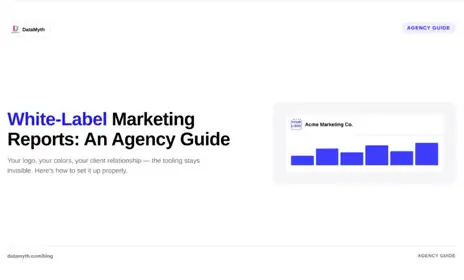
The report you send a client is not just data, it is a touchpoint with your brand. When it arrives covered in another tool’s logo, you are advertising your vendor instead of yourself, and you are quietly telling the client you are a reseller rather than the expert. White-label marketing reports fix that, letting every report you deliver look like it came from your agency and no one else. Here is why that matters and how to do it well.You can see how DataMyth applies your branding in its automated reporting features.
White-label internet marketing reports are performance reports for online channels, such as paid search, paid social, web analytics and CRM, that carry your agency’s brand instead of the software vendor’s. The client sees your logo, your colors and their own name.
They cover the channels you already manage for clients. DataMyth connects Google Ads, Meta Ads, LinkedIn Ads, GA4 and HubSpot with a single OAuth sign-in, then produces reports with your client’s branding, logo and colors. Each report includes written analysis of what changed, why it happened and what to do next.
See how this works on the DataMyth features page.
At first glance, white-labeling looks cosmetic, just swapping a logo. But client relationships are built on perceived expertise, and every branded touchpoint reinforces or undermines that perception. A report carrying a third-party tool’s branding subtly signals that the insight came from software, not from you. A report carrying your agency’s brand signals the opposite: that this analysis is your work, your expertise, your value.
For agency reporting, that perception directly affects retention and pricing. Clients pay for expertise they trust, and consistent branding is one of the quiet ways trust accumulates. White-labeling is not vanity; it is positioning.
For small and growing agencies, white-label marketing reports offer a second advantage: they let you present at a scale beyond your headcount. A two-person agency delivering polished, fully branded reports looks every bit as established as a twenty-person shop. The client does not see the tools behind the curtain; they see a professional operation that produces professional deliverables.
This matters most when you are competing for larger clients who expect a certain level of polish. Branded client reports signal that you take the relationship seriously and have the systems to support it, closing the credibility gap that small agencies otherwise face against bigger competitors.
Effective white-labeling goes beyond dropping your logo in a corner. The elements that make a report feel genuinely yours:
A good white-label reporting tool makes all of this fast to apply, so branding is a setup step rather than a per-report chore. If you are shortlisting options, you can compare reporting tools on price, analysis and white-label support.
Not every tool brands reports the same way. Before you commit, check four things:
1. Where branding is applied. Is it the report only, or other client-facing elements too?
2. Which plans include it. Some tools reserve full white-label for higher tiers. Check the pricing page of each tool you compare.
3. Whether analysis is written for you. A branded dashboard still leaves you to write the story. DataMyth writes the analysis into every report.
4. Channel coverage. Make sure the tool connects the platforms your clients use.
To compare options side by side, see our reporting tool comparisons. If the widest integration catalog matters most to you, AgencyAnalytics may be the better fit (as of September 2026). Our [DataMyth vs AgencyAnalytics page](https://www.datamyth.com/datamyth-vs-agencyanalytics/) has the details.
Here is the catch that trips up many agencies. Custom-branding every report by hand, exporting data, dropping in logos, formatting, adding the client’s name, is exactly the kind of manual work that eats an agency’s hours. As per the survey DataMyth conducted, marketers spend around 7.5 hours a week building reports with analysis. If white-labeling adds friction to that, it becomes a burden rather than a benefit. Here is a practical process to automate reports across a whole roster without adding headcount.
The solution is automation. The right approach lets you set your branding and the client’s details once, then generate branded reports on demand without rebuilding the presentation every cycle. With DataMyth, you can add each client’s logo and name, update it at any time, and produce branded reports with data, graphs, and written analysis in minutes rather than hours. White-labeling stops being extra work and becomes a default state.
For agencies managing many clients, agency client reporting at scale introduces a consistency challenge. Each client needs their own branding, their own metrics, their own cadence, and doing that manually across a full roster is where reporting quality slips under pressure. Reports get rushed, branding gets inconsistent, and the polish that white-labeling promised erodes.
Automating branded, per-client reports keeps quality consistent no matter how many clients you serve. Every client gets a report that looks purpose-built for them, whether you have five clients or fifty, without the reporting workload scaling linearly with your roster. That consistency is what lets an agency grow without its reporting falling apart.
It is worth remembering that a beautifully branded report is still only as valuable as what it says. White-label marketing reports that look professional but contain only raw charts still leave the client to interpret the data themselves. The strongest reports pair your branding with genuine insight, the written analysis of what changed and why, so the client gets both a report that looks like your expertise and content that proves it.
That combination, your brand plus real explanation, is what makes reporting a retention tool rather than a formality. The branding earns the first impression; the insight earns the renewal.
Every report you send is a chance to reinforce your agency’s value or to dilute it. White-label marketing reports ensure each one reinforces it, presenting your work under your brand, personalized for each client, and delivered without the manual burden that makes branding feel like a chore. Set your branding once, automate the delivery, pair it with real insight, and let every report you send quietly build the case for keeping you.
They are client reports branded entirely as your agency’s own, carrying your logo and identity rather than a third-party tool’s. They let you present marketing data as your expertise instead of advertising the software behind it.
Branded reports build client trust, reinforce your expertise, and let small agencies look as established as larger ones. Consistent branding across every report supports retention and helps justify your pricing.
It shouldn’t. With an automated reporting tool, you set your branding and each client’s details once, then generate branded reports in minutes, so white-labeling becomes a default state rather than a manual per-report task. You can review DataMyth plans to see what fits your client roster.
No. Branding earns the first impression, but the report still needs real insight. The strongest white-label reports pair your branding with written analysis of what changed and why, so the report proves your value as well as displaying your name.
They are reports on your clients’ online marketing performance, covering channels like Google Ads, Meta Ads, LinkedIn Ads and GA4, branded as your agency’s own. Your logo and identity replace the software vendor’s, so the report reads as your work and not a reseller’s output.
Connect your client’s ad and analytics accounts, apply the client’s branding, then generate the report. In DataMyth, you connect with one OAuth sign-in and get a branded report with AI-written analysis in about 3 seconds (HubSpot reports take about a minute). No CSV exports are needed.
Your logo, the client’s name and logo, consistent branding across every report and a clean layout. It should also include written analysis: what changed, why it happened and what to do next. Branding earns the first impression. Insight earns the renewal.
It depends on the tool. Some platforms reserve full white-label for higher tiers, so check each plan before you buy. DataMyth pricing is credit-based, and you can see current plans on the pricing page. The 7-day free trial requires no credit card.